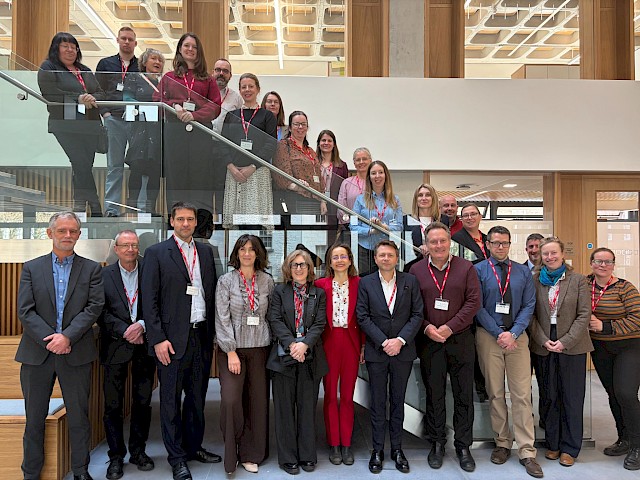
| | The Irish Government hosted the Offshore Industry Committee (OIC) meeting in Dublin on 9 – 13 March 2026, in the week preceding St. Patrick`s Day. Ms Hennessy, the Assistant Secretary Circular Economy and Resource Efficiency of the Department of Climate, Energy and the Environment gave a warm welcome to Contracting Parties and OSPAR observer organisations.
Since 2023 OIC has been with no Chair and relying in the Vice-Chair of OIC, Robert Doerband from Germany. He has been acting as Chair of the last three OIC meetings and representing the Committee inside the OSPAR family. With his support OIC has been able to continue its work and make progress to deliver the OSPAR North-East Atlantic Environment Strategy (NEAES) 2030. Fortunately, OIC has elected a new Chair, Teresa Munro from the United Kingdom, for the 2026-2028 period and Robert Doerband will continue supporting as Vice-Chair.
OIC reports annually the discharges, spills and emissions from offshore oil and gas installations and in the future this reporting exercise will improve to enable the collection of heavy metals in produced water including the mass of lead, cadmium, and mercury discharged.
Under the OSPAR Harmonised Mandatory Control System (HMCS) for use and reduction of discharges of offshore chemicals by the offshore oil and gas industry, the OSPAR List of Substances/Preparations Used and Discharged Offshore which are Considered to Pose Little or No Risk to the Environment (PLONOR) was reviewed and OIC has recommended to add trisodium hydrogen carbonate (also known as sodium sesquicarbonate) to the list.
Because Per- and Polyfluoroalkyl Substances (PFAS) were included in the last update of the List of Chemicals for Priority Action and the List of Substances of Possible Concern, OIC is collecting feedback on the use and discharge of identified PFAS-containing products.
Following the Vigo Declaration adopted by the Ministerial Meeting in 2025, OIC is aiming to reduce the number of derogations to leave disused offshore installations in situ, in the light of progress in technology development and through the application of Agreement 2024-04: Guidance on the application of OSPAR Decision 98/3 on the Disposal of Disused Offshore Installations. The meeting agreed to a baseline of potential derogations against which to measure progress in future years and the United Kingdom already presented a ‘pilot’ reflecting.
Updates were given by Contracting Parties on their carbon dioxide storage projects in the OSPAR maritime area. The majority of the projects are on the preliminary phases to obtain exploration and storage permits and a very few are operational. A presentation was provided on the development of CCS monitoring covering early demonstration projects and commercial deployments.
Discussions were held on the potential amendments of the OSPAR Convention to cover carbon dioxide capture and storage (CCS) and hydrogen production and storage (HPS) activities. A first draft is already in place needing further work depending on the potential amendments on renewables as well as clarification on why amendments in relation to the storage of carbon dioxide should not be limited to offshore oil and gas activities.
OIC thanked Saravan Marappan from the United Kingdom for his exceptional work in support of OIC, as Chair of the Committee and Head of Delegation for the United Kingdom and Laura de la Torre from the Secretariat in supporting the Chair and Vice-Chairs of OIC.
Meeting in Dublin offered a great opportunity to carefully plan the work ahead to continue protecting the OSPAR Maritime Area of the impacts of the offshore oil and gas industry. |
| | |
|