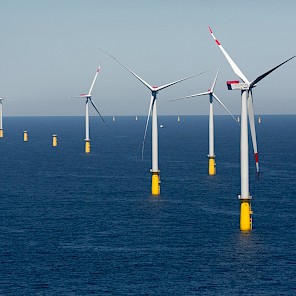
| | The OSPAR Maritime Area has undergone a profound transformation in its offshore energy landscape since the Quality Status Report (QSR) 2023. Offshore wind remains a dominant and rapidly expanding use of coastal and shelf seas within the region, while tidal, wave, and emerging technologies such as floating solar are progressing through the pre-commercial phase. Our latest report summarises current distribution, trends and environmental status, and identifies key management and governance considerations for OSPAR Contracting Parties.
European offshore wind capacity grew from approximately 22 GW in 2019 to approximately 36.7 GW by end-2024, with the United Kingdom (~16.6 GW), Germany (~9.7 GW), the Netherlands (~4.7 GW), Denmark (~2.6 GW), Belgium (~2.3 GW), and France (~1.5 GW) accounting for the majority of deployed capacity. Development is concentrated in the Greater North Sea and Celtic Seas sub-regions, reflecting their favourable wind resources and shallow-water conditions. Average turbine capacity for new installations now exceeds 9.5–10.5 MW, wind farm sizes average approximately 950 MW, and projects are increasingly sited further from shore in water depths of 35–40 m or greater.
Overall, offshore renewable energy is becoming a structural feature of the OSPAR maritime space and will remain so for the foreseeable future. The priority challenge is not only to facilitate deployment at the pace required by climate targets, but to ensure that cumulative, cross-border, and long-term environmental effects are anticipated, monitored, and adaptively managed. This will require strengthened regional coordination; harmonised monitoring standards; integrated spatial planning that moves from project-level EIA toward ecosystem-scale assessment; and targeted investment in the priority evidence gaps that currently constrain consenting and cumulative risk appraisal.
Image: Shutterstock | |
| | |
|
 READ MORE