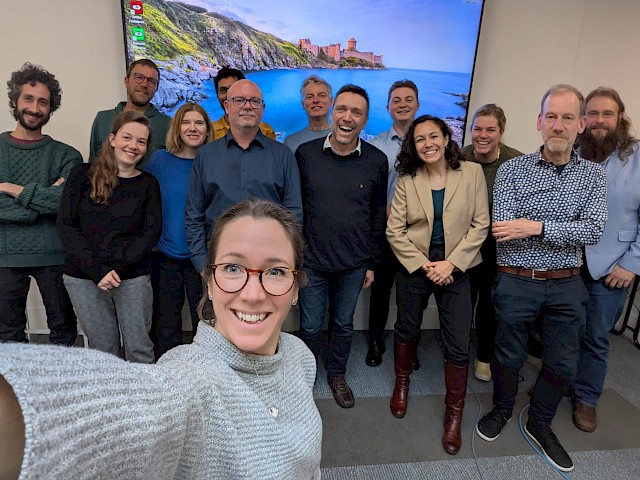
| | Last week, against the backdrop of the waterfront in La Rochelle, the Intersessional Correspondence Group on Biodiversity Assessment and Monitoring (ICG-COBAM) came together for an Intermediate Assessment 2029 (IA 2029) planning extravaganza. In a light-filled meeting space by the water, experts tackled an ambitious agenda covering data calls, indicator proposals, assessment methods, and delivery timelines. With ICG-COBAM set to deliver more than 60 indicator assessments for IA 2029, it was a full and fast-paced few days.
At the heart of this work is ICG-COBAM’s dedicated expert community, coordinated by convenors Jos Schilder (Netherlands) and Ian Mitchell (UK). The meeting explored proposals from OSPAR biodiversity expert groups for pilot assessments of new indicators spanning non-indigenous species, birds, benthic habitats, demersal fish communities, and elasmobranchs (including sharks, skates, and rays). Participants also revisited a pilot food web assessment, testing ecological network analysis indices for the second time.
Building on existing work, the group considered proposed extensions to current indicators for marine mammals, fish, non-indigenous species, and pelagic habitats. These extensions focus on OSPAR’s Arctic Region I and the wider Atlantic Region V. As indicator coverage expands across the vast and varied Arctic, discussions also turned to the possibility of subdividing Region I into smaller eco-regions—an important step toward producing higher-quality assessments that better reflect the region’s biological and physical diversity.
One of the most thought-provoking sessions tackled a long-standing challenge: how to integrate multiple indicator results into a single, coherent picture of ecosystem status. A promising new integration method, presented by the marine mammal expert group, sparked lively discussion. This approach will be tested in upcoming marine mammal assessments and explored by other expert groups as they refine their own integration strategies.
Looking ahead, the immediate priority is clear: continuing to gather the most up-to-date data for IA 2029. OSPAR Contracting Parties are being called upon to strengthen the evidence base for all biodiversity indicators. As assessments are delivered in 2027 and 2028, they will provide our most comprehensive picture yet of the status of biodiversity in the North-East Atlantic. |  | | For more information on biodiversity monitoring and assessment | |  READ MORE
 |
| |  | | For more information on the OSPAR Commission | | |
READ MORE |
|
|
| | |
|