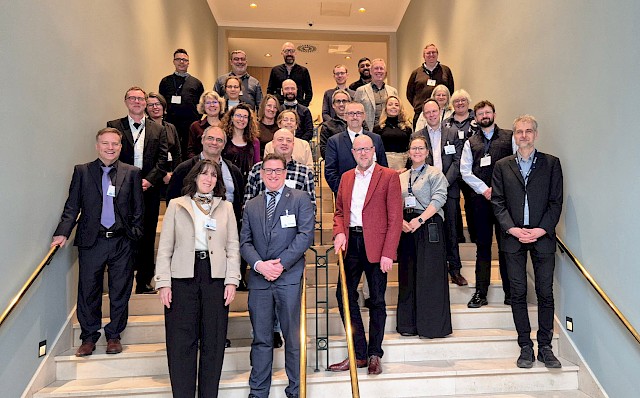
| | From Chair Adam Stackhouse (UK)Following the successful conclusion of the 2026 Radioactive Substances Committee (RSC) Meeting, held in Brussels on 10–13 February 2026 at the kind invitation of Belgium, I am pleased to share a summary of the key outcomes and forward priorities agreed by the Committee.
The meeting brought together Contracting Parties and OSPAR observer organisations to review progress and take important decisions supporting delivery of the OSPAR North-East Atlantic Environment Strategy (NEAES) 2030 and the Joint Assessment and Monitoring Programme (JAMP). I would like to thank all delegates for their constructive engagement and well-prepared contributions.
Key Outcomes and Decisions
Planning and Delivery to 2030: Recognising that the recent Ministerial meeting marked the mid-point of the NEAES 2030 Strategy, the Committee reaffirmed the importance of maintaining credible and realistic delivery plans through to 2030. Contracting Parties were invited to reflect on the resources they are able to commit to RSC work and how these commitments align with agreed priorities. The discussion also revisited the added value of working through OSPAR, reinforcing the importance of collective action to achieve shared environmental objectives.
Preparation of the first RSC Indicator assessments: RSC is preparing its first ever Indicator assessments. Work progressed on clarifying timelines and identifying potential delivery risks of the Indicator assessment on discharges to the marine environment from the nuclear sector. These Indicator assessments will contribute to OSPAR Intermediate Assessment 2029. During 2026-2027 RSC will work on the specifications for a second OSPAR RSC indicator on discharges from the non-nuclear sector.
Discharges from the nuclear sector: Data reported to OSPAR show that the 2024 total alpha and total beta discharges from the nuclear sector are the lowest on record (since 1989). RSC also spent time considering how to better communicate this data and agreed to develop proposals for implementation next year. In the meantime, the data and assessment are available in OAP and ODIMS with the latest data and reports expected to be published in the summer following agreement by the OSPAR Commission.
RSC also considered the national report from Spain and concluded that they were meeting their commitments to apply best available techniques and best environmental practice to prevent pollution from radioactive substances from the nuclear sector. The continued commitment of all Contracting Parties to prevent pollution from radioactive substances has led to the lowest discharges from the nuclear sector on record.
Memorandum of Understanding with IAEA: A significant milestone was the official signing of the new Memorandum of Understanding between OSPAR and the International Atomic Energy Agency (IAEA), strengthening cooperation on radioactive substances in the marine environment. Areas of focus include cooperation on quality assurance of environmental monitoring data=and the development of safety standards related to the deployment of nuclear technologies such as floating nuclear power plant.
Monitoring of Atlantic dumpsites: We are grateful to France and Portugal for presentations on the monitoring of historic Atlantic dumpsites. P. Chardon and J. Escartín (CNRS, France) gave a welcome presentation on the NODSSUM Project (Nuclear Ocean Dump Site Survey and Monitoring), and Portugal updated RSC on the monitoring of historic dumpsite in the Macaroneisan area.
Elections: As the meeting marked the end of my second term as Chair, the Committee considered the positions of Chair and Vice Chair(s) for the period to 2028. I am proud to have been voted in as Chair for a third term. Guilherme Cardoso (Portugal) will continue to support me as Vice Chair and we are thrilled to be joined by Karin Aquilonius (Sweden).
Goodbyes and thank yous: I would like to extend my sincere thanks to all Contracting Parties, task leads, ICGs, EAP convenors, and expert groups for their continued dedication. Your commitment is fundamental to delivering NEAES 2030 objectives and JAMP outputs. I would also like to take the opportunity to say a huge thank you to Deputy Secretary, Laura De La Torre, Carol Robinson (Norway), Andy Pynn (UK) and Pilar Lopez Ferrando (Spain) who are leaving RSC.
The momentum and clarity achieved at RSC 2026 provide a strong foundation for the next phase of our work. I look forward to continuing our collaboration in the intersessional period and at our next meeting.
With warm regards,
Adam Stackhouse
Chair, Radioactive Substances Committee (RSC) |
| | |
|