Observers
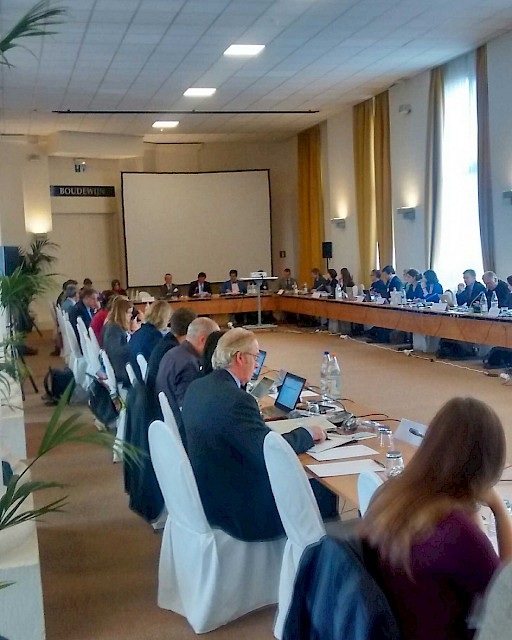
The observer organisations play an essential role in the OSPAR Commission. They include other intergovernmental organisations working in similar fields, and international non-governmental organisations. The non-governmental observer organisations are environmental protection and nature conservation organisations, industry and trade organisations and organisations of regional and local authorities.
While the primary responsibility of carrying out the OSPAR Convention lies with the Contracting Parties, the observer community plays an essential role in the promotion of protecting and conserving the North-East Atlantic and its resources. The observers not only take part in the various meetings of the OSPAR Commission but also contribute actively to its work and to shaping policy development. In this way non-governmental organisations are essential partners in the implementation of the Convention and translating its principles into practical action at local, national and regional level.
Applications for Observer status from Non-Governmental Observer Organisations
Information on how Non-Governmental Observer Organisations can apply for observer status can be found in the Rules of Procedure of the OSPAR Commission: Criteria and procedures governing observership of Non-governmental Organisations and Indigenous Peoples Organisations (Agreement 2013-02). These criteria and procedures give information on deadlines for the submission of applications and a description of the information that needs to be submitted.
Applications from Non-Governmental Observer Organisations should be received at least 12 weeks before the meeting of the OSPAR Commission.
The deadline for submissions in 2027 is 26 March 2027.
Intergovernmental organisations
The following intergovernmental organisations have observer status to OSPAR:
- Abidjan Convention Secretariat
- Agreement on the conservation of small cetaceans of the Baltic and North Seas (ASCOBANS)
- Arctic Monitoring and Assessment Programme (AMAP)
- Baltic Marine Environment Protection Commission (Helsinki Commission)
- Barcelona Convention
- Black Sea Commission
- Common Wadden Sea Secretariat (CWSS)
- Cooperative Programme for Monitoring and Evaluation of Long-Range Transmission of Air Pollutants in Europe (EMEP)
- European Environment Agency (EEA)
- Intergovernmental Oceanographic Commission (IOC)
- International Atomic Energy Agency (IAEA)
- International Commission for the Conservation of Atlantic Tunas
- International Commission for the Protection of the Rhine
- International Council for the Exploration of the Sea (ICES)
- International Maritime Organisation (IMO)
- International Seabed Authority (ISA)
- North Atlantic Marine Mammal Commission (NAMMCO)
- North Atlantic Salmon Conservation Organization (NASCO)
- North-East Atlantic Fisheries Commission (NEAFC)
- Organisation for Economic Cooperation and Development (OECD)
- Sargasso Sea Commission
- United Nations Environment Programme (UNEP)
Non-governmental organisations
The following non-governmental organisations have observer status to OSPAR:
- Advisory Committee on the Protection of the Sea (ACOPS)
- Atlantic International Research Centre (AIR Centre)
- Bellona Environmental Foundation
- BirdLife International
- Central Dredging Association (CEDA)
- Concawe (Scientific Division of the European Fuels Manufacturers Association)
- Conference of Peripheral Maritime Regions of Europe (CPMR)
- Conseil Européen des Fédérations de l'Industrie Chimique (CEFIC)
- Cruise Lines International Association (CLIA)
- Deep Sea Conservation Coalition (DSCC)
- EnerGeo Alliance (formerly IAGC)
- EUCC - the Coastal Union
- Eurofeu
- EURO CHLOR Federation
- European Anglers Alliance (EAA)
- European Association of Fish Producers Organisation (EAPO)
- European Boating Association (EBA)
- European Boating Industry (EBI)
- European Oilfield Speciality Chemicals Association (EOSCA)
- European Soap and Detergent Industry (AISE)
- EUROPECHE, Association of National Fisheries Organisations
- European Subsea Cables Association (ESCA)
- Fauna & Flora
- Fertilizers Europe (formerly European Fertilizers Manufacturing Association)
- Friends of the Earth International (FOEI)
- Global Ghost Gear Initiative (GGGI)
- Greenpeace International
- International Association of Oil and Gas Producers (IOGP)
- International Chamber of Shipping (ICS)
- International Dialogue on Underwater Munitions (IDUM)
- Kommunenes Internasjonale Miljøorganisasjon (KIMO)
- Mercator Ocean International
- Natural Resources Defense Council (NRDC)
- Nordic EPS Alliance (NEPSA)
- North Sea Advisory Council (NSAC)
- Nuclear Transparency Watch (NTW)
- OCEANA
- Pew Charitable Trust (Pew)
- PlasticsEurope
- Renewables Grid Initiative
- Robin des Bois
- Seas at Risk
- Union of the Electricity Industry (EURELECTRIC)
- Wind Europe
- World Nuclear Association
- World Wide Fund for Nature (WWF)