Frequently Asked Questions
 In the drop downs below you will find the answers to some of the most frequently asked questions about OSPAR's Intermediate Assessment 2029.
What is the Intermediate Assessment 2029
OSPAR's Intermediate Assessment (IA) 2029 will build on the Quality Status Report 2023 to provide the most up-to-date assessment of the status of the North-East Atlantic for the period. It aims to increase our knowledge and understanding of the marine environment through OSPAR’s monitoring and assessment process. It will look at both the current state of the marine environment and ecosystems, and at human activities benefiting from the marine environment and interacting with it.
The objective of the IA 2029 is to assess the environmental status of the North-East Atlantic against the objectives of OSPAR's North-East Atlantic Environmental Strategy and identify priority elements for action to achieve OSPAR’s vision of a clean, healthy and biologically diverse North-East Atlantic Ocean, which is productive, used sustainably and resilient to climate change and ocean acidification. In addition, an Intermediate Assessment may also be used by Contracting Parties to support other priority activities including, for Contracting Parties that are also EU Member States, in support of their reporting obligations under the Marine Strategy Framework Directive (MSFD).
Where do we assess?
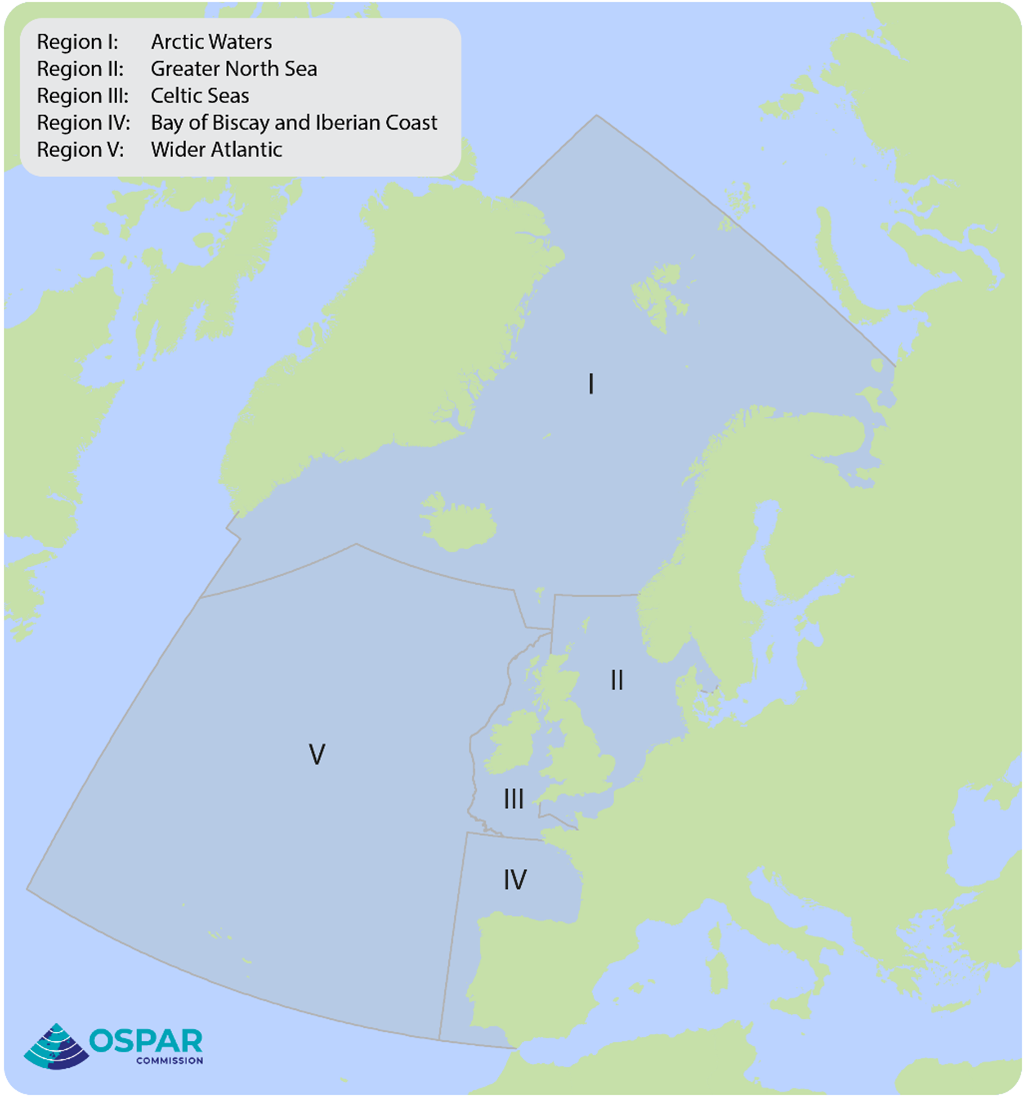 The assessment will cover the OSPAR Maritime Area, comprising the OSPAR regions (Region I: Arctic Waters, Region II: Greater North Sea, Region III: Celtic Seas, Region IV: Bay of Biscay and Iberian Coast, and Region V: Wider Atlantic).
Who is involved?
The IA 2029 is an ambitious collective endeavour involving the whole OSPAR network. The 16 Contracting Parties to the OSPAR Convention are the primary contributors, nominating more than 800 experts to lead on the delivery of the various assessments which form the scientific bedrock of the IA. The contributions of OSPAR Observers from intergovernmental partner organisations and blue economy and environmental non-governmental organisations help to close any information gaps in data, a crucial aspect of this assessment and monitoring process. The OSPAR Secretariat oversees the coordination of the process.
The IA 2029 is delivered as a part of OSPAR’s joint monitoring and assessment programme (JAMP – OSPAR Agreement 2024-01). It is further defined in the IA 2029 Guidance Document (OSPAR Agreement 2025-04). The main building blocks of the IA 2029 will be OSPAR assessments on specific topics as defined in the JAMP.
Why does OSPAR perform assessments of the North-East Atlantic?
Scientific knowledge is indispensable as the basis for the sustainable use of the marine environment and as such is at the core of OSPAR’s mandate.
The OSPAR Convention Article 6 sets out the obligation “The Contracting Parties shall, in accordance with the provisions of the Convention, in particular as provided for in Annex IV:
(a) undertake and publish at regular intervals joint assessments of the quality status of the marine environment and of its development, for the maritime area or for regions or sub-regions thereof;
(b) include in such assessments both an evaluation of the effectiveness of the measures taken and planned for the protection of the marine environment and the identification of priorities for action.
In carrying out the IA 2029, OSPAR is pursuing a number of key objectives:
- To fulfil a requirement set out in the OSPAR Convention, which requires Contracting Parties, through the Joint Assessment and Monitoring Programme, to cooperate in both monitoring and assessment of our seas
- To assess the environmental status of the North-East Atlantic against the objectives of the North-East Atlantic Environment Strategy 2030
- To gather/produce scientific knowledge
- To identify possible new threats to the marine environment of the OSPAR Maritime Area
- To deliver regionally on cross-cutting issues such as climate change or ocean acidification
- To assess the effectiveness of OSPAR actions and measures
- To identify the priority elements for actions to achieve OSPAR’s vision, by using the findings to develop the tasks under the North-East Atlantic Environment Strategy 2030.
What do we assess?
The IA 2029 is an holistic assessment that covers the marine environment of the North-East Atlantic and the pressures from human activities impacting it, as well as the benefits which humans derive from a healthy and thriving ocean. It will bring together over 70 individual OSPAR assessments that address marine species and the habitats they depend on, the intensity of human activities in the sea and pressures they result including radioactive substances, offshore oil and gas industries, renewable energy generation, tourism and many more. Pollution from nutrients and hazardous substances, and other pressures such as marine litter, underwater noise are also addressed. Finally, the IA 2029 will consider the impacts of climate change on the North-East Atlantic.
What are the components of the IA 2029?
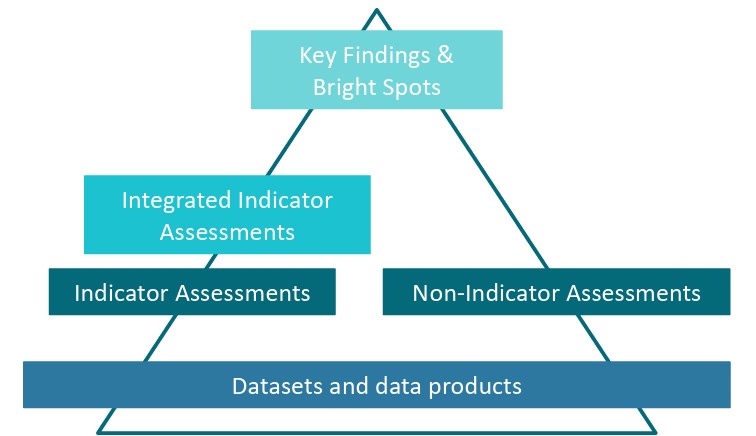
The IA 2029 will comprise several components that bring together a large amount of information from different sources through a structure of increased integration. In other words, the IA 2029 could be compared to a ‘pyramid’ with data as its foundation, and different assessments processing and analysing the data and information being brought together (Figure 1).
How do OSPAR Contracting Parties who are also EU member states coordinate monitoring and assessment for the EU Marine Strategy Framework Directive (MSFD)?
For Contracting Parties that are also European Union (EU) member states, the IA 2029 will provide a valuable contribution to their obligations under the Marine Strategy Framework Directive, particularly in relation to the assessments required under MSFD Article 8 (assessment of the current environmental status of Member states' marine waters and of the predominant pressures and impacts upon them). To ensure the efficient use of Contracting Parties’ resources and avoid duplication, the IA 2029 will, wherever possible, deliver outputs that are compatible with MSFD reporting requirements in order to supplement the reporting efforts of Member states in 2024, acknowledging that the IA 2029:
- is an OSPAR product delivered for all OSPAR Contracting Parties;
- covers areas beyond EU Member State marine waters;
- does not cover all aspects needed for MSFD reporting (e.g. not all MSFD Descriptors are assessed); and
- may cover aspects beyond the topics relevant for the MSFD.
When will the results of the IA 2029 be available?
The results of the IA 2029, in the form of different assessments, will be agreed for publication during the OSPAR Commission meetings of 2026, 2027 and 2028 as the IA 2029 process runs over several years. It will come to an end in 2029, when the key findings will be agreed for publication by the OSPAR Commission in early summer 2029.
Where are the results available?
The IA 2029 will be an online publication, with assessments presented through a dedicated section of the OSPAR Assessment Portal, https://oap.ospar.org/.
The components will be published via the online interface, supplemented with images, interactive charts/figures, and maps. There will be clear cross linkages made between corresponding elements within the IA 2029 with links to the OSPAR Data and Information Management System, https://odims.ospar.org for access to the data underpinning the assessments. The key findings report will be available in both English and French.