Underwater Noise
Marine mammals, many fish species and even some invertebrates communicate using sound to find mates, to search for prey, to avoid predators and hazards, and for navigation.
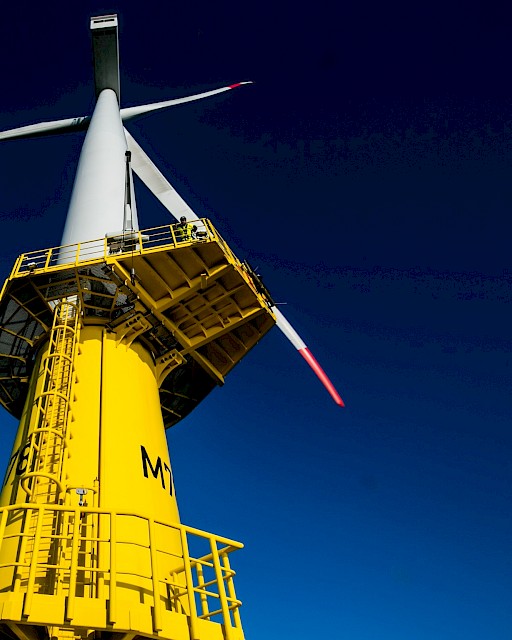
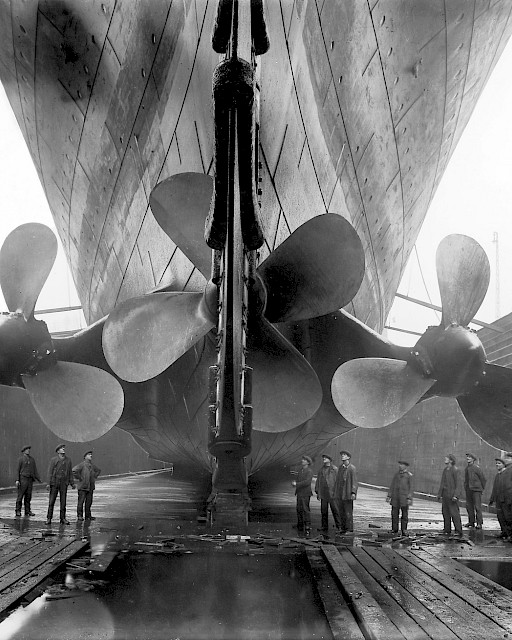
Many of the human activities that take place in the OSPAR Maritime Area generate sound and contribute to the general background level of noise in the sea. Anthropogenic noise sources are categorised as impulsive or continuous. Impulsive noise sources include percussive pile driving for inshore and offshore construction (e.g. windfarms) seismic surveys (using airguns) to inspect subsea oil and gas deposits, explosions, and some sonar sources. Continuous noise sources are mainly from shipping.
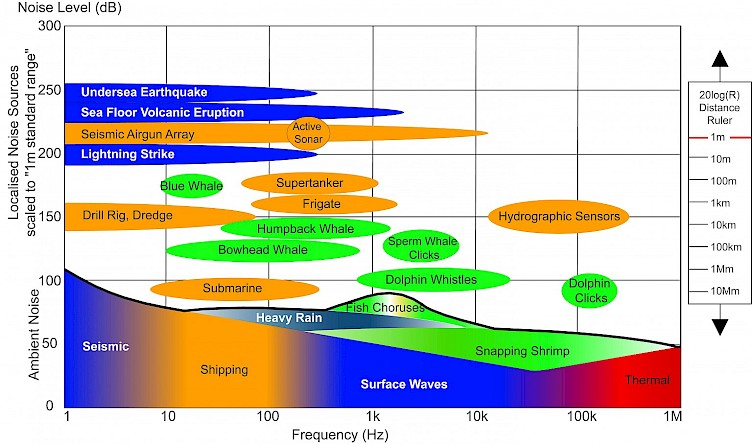
Levels and frequencies of anthropogenic and naturally occurring sound sources in the marine environment. Spectrum Noise Level (“Acoustic Intensity per Hertz”) versus Frequency (measured in Hertz or “cycles per second”). The vertical axis is expressed in decibels (dB; the reference for the dB calculation is the acoustic intensity of a sound wave, in water, of root-mean-square pressure 1µPa ). While ambient noise sources do not need to be corrected for range, localised noise sources are all scaled to “1 m standard range”. The scaling ruler on the right-hand side of the figure may be used to gauge the loss corresponding to the distance from any localised noise source assuming spherical spreading. Colour scheme: anthropogenic (man-made) noise sources are depicted in orange, biological underwater noise sources in green and environmental noise sources in blue. Source: Coates, 2002 ©Seiche Ltd. 2006
Our latest assessments: Quality Status Report 2023
Briefing note on the thematic assessment
Distribution of Reported Impulsive Sounds in the Sea: Reported impulsive noise activity increased overall during the assessment period (2015-2019), with most reported activity occurring in the North Sea. Seismic airgun surveys were the dominant sound source. Since data are unavailable for some countries and sound sources, these results represent an under-estimation of activity in the OSPAR Area.
Risk of Impact from Anthropogenic Impulsive Sound: Estimated risk of disturbance to harbour porpoise from reported anthropogenic impulsive sound decreased by 48% from 2015 to 2017, then increased 31% from 2017 to 2019. Exposure of harbour porpoise to anthropogenic impulsive sound was typically greatest during August-October. More comprehensive reporting will improve confidence in the assessment.
Pilot Assessment of Ambient Noise: Shipping noise is dominant in the underwater soundscape of the North Sea. In the southern part and along the major shipping routes the noise exceeds the natural sound by more than 20 dB for more than 50% of the time. Marine protected areas (MPAs) don’t seem to give additional protection against continuous noise.
Impacts of Underwater Noise
Underwater sound from anthropogenic sources has the potential to mask biological signals and to cause behavioural reactions, physiological effects, injuries and mortality in marine animals.
Impacts depend on both the nature of the sound and the acoustic sensitivity of the organism. There are difficulties in quantifying the extent and scale of the impacts, as there is great variability in the characteristics of the sounds, the sensitivities of different species and the scale of noise-generating activities. Ambient or background noise is not range-dependent and remains constant irrespective of location. The perception of localised noise sources reduces with increasing distance from each source, eventually becoming indistinguishable from ambient noise.
In 2025 OSPAR published an update to its OSPAR inventory of measures to mitigate the emission and environmental impact of underwater noise, to date containing chapters on pile driving, seismic surveys, shipping and explosive use. This OSPAR inventory aims to focus on certain human activities which are considered of prime concern. It is designed to help Contracting Parties in avoiding and reducing the introduction of underwater noise generated by certain human activities and its environmental impacts by applying appropriate mitigation measures.
Monitoring and assessment
Impulsive noise
An impulsive noise risk of impact indicator as well as an indicator on distribution of reported impulsive sounds in the sea was published as part of the QSR 2023. This assessment is based on the data reported to the Impulsive Noise Registry.
This registry assembles data supplied by Contracting Parties to OSPAR and HELCOM (Baltic Sea). The data are collated nationally from registers of licenced events such as pile driving, controlled explosions from naval operations and other activities that release energy.
Continous (Ambient) Noise
OSPAR adopted an Ambient Noise Monitoring Strategy in 2015. The approach for monitoring of underwater sound uses sound maps, generated from a combination of models and measurements. Models should be used to place measurement equipment, and to extrapolate from measurements to generate estimates for entire region.
A Pilot Assessment of Ambient Noise was published in 2023 as part of the QSR 2023.
Please note: EIHA 2026 agreed to use the term ‘continuous noise’ rather than ‘ambient noise’ and that the Secretariat and the co-convenors of the ICG-Noise would identify all OSPAR’s measures and publications that need to be amended accordingly.
Data on underwater noise is available here.
OSPAR Regional Action Plan for Underwater Noise
Briefing note on the RAP-Noise
Underwater noise is often a transnational phenomenon. Sound underwater can propagate over very large distances, and many marine species have habitats that cross international boundaries. Therefore, management of underwater noise can best be organised through regional and international co-operation, and collaboration between OSPAR’s Contracting Parties
In 2025, OSPAR adopted a dedicated Regional Action Plan to reduce anthropogenic underwater noise to levels that do not adversely affect the marine environment. The action plan is implemented from 2025 to 2035 and bring together the best from the Contracting Parties’ scientific and policy communities and contributes to delivering relevant objectives of the North-East Atlantic Environment Strategy 2030 and address knowledge gaps identified in the OSPAR Science Agenda. Targeting the most important sources of underwater noise, 8 prioritised actions address overall levels of noise pollution as well as specific sources of this pollution by developing harmonised targets, standards and approaches towards the reduction of anthropogenic noise. OSPAR is actively engaging with relevant stakeholders and communities to support the implementation of its ambitious action plan.
ICG-Noise
OSPAR's work on Underwater Noise is coordinated through the Intersessional Correspondence Group on Underwater Noise (ICG Noise). The group reports into OSPAR's Environmental Impacts of Human Activities Committee. The Terms of Reference for the group can be found here.